
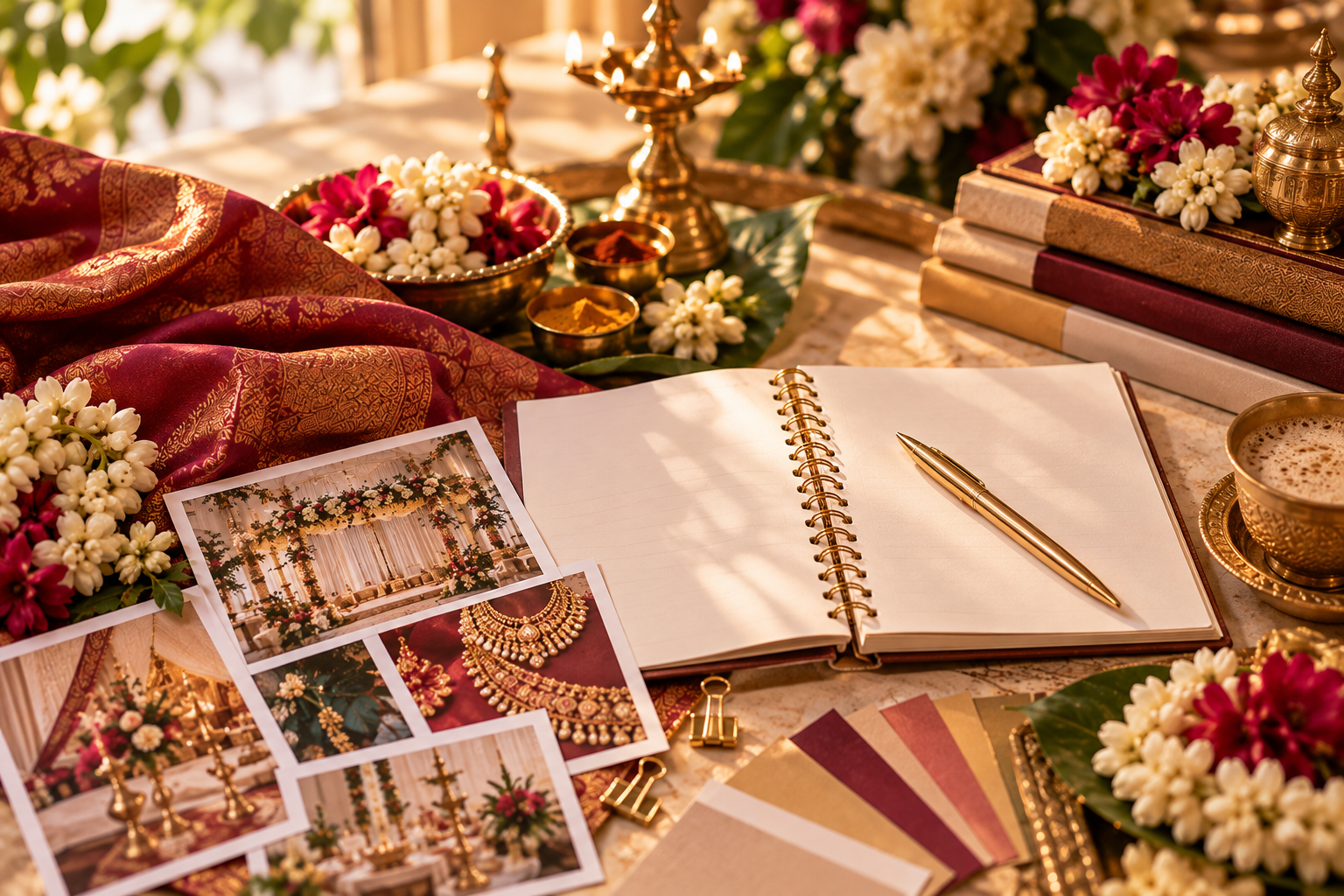
There may be dates to consider, ceremonies to understand, family discussions to navigate, guest lists to build, vendors to compare, outfits to choose and countless little details that suddenly seem to need your attention at the same time.
But you don't have to plan your entire wedding in one weekend.
Whether you're planning an intimate temple ceremony, a large reception, several traditional celebrations or a wedding that blends old traditions with your own modern style, this guide will help you understand where to begin and what to plan next.
1. Start with the wedding you actually want
Before looking at venues or scrolling through wedding décor inspiration, spend some time talking about what you both want your wedding to feel like.
Do you imagine something intimate and meaningful, or a large celebration surrounded by extended family and friends?
Would you prefer a traditional celebration, something contemporary, or a combination of both?
Are there particular ceremonies that are especially important to either family?
And perhaps most importantly: when you look back at your wedding years from now, what do you hope you'll remember most?
You don't need every answer immediately.
The purpose of this conversation is simply to identify your priorities. When you know what matters most to you, decisions about your budget, venue, guest list and vendors become much easier.
It also gives both families an opportunity to understand the kind of celebration you're hoping to create.
2. Understand your ceremonies and family traditions
There is no single template for an Indian wedding.
The ceremonies, customs and order of events can differ depending on religion, community, family traditions and personal preference. Even two families with similar backgrounds may celebrate certain moments differently.
That's why one of your earliest planning conversations should be with both families and, where relevant, the priest, temple or religious representative conducting your ceremony.
Start by identifying which ceremonies you will be having and what each one requires.
For some couples, this may include a Nichayathartham, or engagement ceremony, before the wedding itself. Other pre-wedding and wedding-day traditions will depend on your families and the customs you choose to observe.
Understanding these ceremonies early helps you determine how many events you're actually planning—and prevents important requirements from appearing unexpectedly later.
Don't worry about making your wedding identical to somebody else's.
Tradition can provide the foundation while still leaving room for your celebration to feel unmistakably yours.
3. Set a realistic wedding budget
Once you have a clearer picture of the wedding you're planning, it's time to talk about money.
It may not be the most romantic part of wedding planning, but having an honest budget from the beginning can remove a surprising amount of stress later.
Start with the total amount available.
If parents or other family members are contributing, clarify those contributions early rather than building your plans around assumptions.
Then divide the budget into the major areas of your wedding, such as:
- Ceremony and venue
- Catering
- Photography and videography
- Décor and flowers
- Attire and jewellery
- Hair and makeup
- Invitations and stationery
- Entertainment
- Ceremony items
- Transport
- Gifts and favours
- Miscellaneous expenses
Leave some room for unexpected costs too. Small additions have a habit of appearing as the wedding gets closer.
As quotations and deposits begin coming in, keep track of both your estimated cost and actual spending. Seeing the two together makes it much easier to understand where your budget stands before making the next big decision.
4. Build your guest list earlier than you think
Your guest list influences almost every major wedding decision.
A celebration for 150 guests requires very different planning from one for 800.
Your numbers affect the venue, catering, invitations, seating arrangements, favours and ultimately your overall budget.
Start by creating a master list rather than trying to decide the final number immediately.
You can separate guests into groups such as the couple's family, parents' guests, relatives, friends and colleagues. Then review the list together and identify where adjustments may be necessary.
For many Malaysian Indian weddings, the guest list can also involve significant input from both families. Having that conversation early gives everyone more time to work through numbers without the pressure of an approaching invitation deadline.
And keep your guest information organised from the beginning.
Names, contact details, invitation status, RSVP responses and attendance can become surprisingly difficult to manage once they are spread between WhatsApp conversations, notebooks and different spreadsheets.
5. Secure your date, ceremony location and venue
Once you understand your ceremonies, approximate guest count and budget, you can begin confirming where and when everything will happen.
For some families, an auspicious date or time may play an important role in choosing the wedding date. Temple, priest and venue availability can also affect your options.
If these factors apply to your wedding, confirm them before making non-refundable bookings elsewhere.
When comparing venues, look beyond appearance.
Consider capacity, parking, accessibility for elderly relatives, catering arrangements, preparation spaces, décor restrictions, timing restrictions and exactly what is included in the venue package.
If your ceremony and reception are happening at different locations, remember to consider travel time between them too.
Once the date and locations are confirmed, many of the other pieces can finally begin falling into place.
6. Book your key wedding vendors
Popular wedding vendors can be booked months in advance, particularly around sought-after wedding dates.
Start with the vendors whose availability is most important to you.
Depending on your celebration, that might include your:
- Photographer and videographer
- Makeup artist and hairstylist
- Decorator or florist
- Caterer
- Entertainment or musicians
- Mehndi artist
- Emcee
- Wedding coordinator
- Transport provider
Don't choose solely by price or social-media popularity.
Look carefully at portfolios, reviews and the consistency of their previous work. Ask exactly what is included in each package and whether there are additional charges for travel, overtime, assistants, setup or other services.
Before paying a deposit, make sure you understand the payment schedule, cancellation terms and what happens if plans change.
And keep every quotation, payment and contact detail somewhere you can easily find again.
Wedding planning becomes much calmer when you're not searching through six months of messages to remember what a vendor promised.
7. Plan your wedding look
Now comes one of the more enjoyable parts.
Your outfits, jewellery, hair, makeup and accessories help tell the visual story of your wedding—but Indian weddings can involve more than one look.
Start by listing the outfits needed for each ceremony or celebration.
Then think about how they work together rather than choosing every outfit independently.
You might want certain colours to complement the décor or invitation design, while another ceremony may call for something more traditional.
Allow enough time for tailoring and alterations, particularly for pieces that are custom-made.
The same applies to jewellery and accessories. Try everything together before the wedding rather than discovering at the last minute that a necklace doesn't sit correctly with a blouse neckline or that a pair of shoes becomes uncomfortable after ten minutes.
For hair and makeup, reference photos are useful, but choose a look that still feels like you.
Your wedding photographs will last much longer than any passing trend.
8. Design and send your wedding invitations
Your invitation is often the first glimpse guests receive of your wedding.
Long before they see the venue, décor or outfits, the invitation begins telling them what kind of celebration to expect.
Once your date, venues and major ceremony details are confirmed, begin gathering the information that needs to appear on your invitation.
Check names carefully. Confirm dates, times and addresses. Decide whether separate events require separate cards or sections, and make sure both families have reviewed important details before the final design is approved.
Then think about the feeling you want the invitation to create.
Traditional and ornate? Soft and romantic? Contemporary and minimal? Rich in cultural detail?
Your invitation doesn't need to reveal every element of the wedding, but it should feel connected to the celebration you're creating.
Starting the invitation process early also gives you time for design development, revisions and—for printed invitations—printing and delivery.
At Riya Invites, we believe wedding invitations should do more than communicate a date and location. They should feel like the beginning of the celebration itself.
9. Turn your plans into a wedding timeline
As the wedding approaches, individual bookings need to become one coordinated plan.
That's where your wedding timeline becomes essential.
Start with the fixed moments—ceremony time, venue access, reception start and any religious timings—then work backwards and forwards from them.
Include things such as:
- Hair and makeup
- Getting dressed
- Photography
- Vendor arrival and setup
- Family arrival
- Ceremony preparations
- Ceremony start
- Travel between locations
- Couple and family portraits
- Reception entrance
- Speeches or performances
- Meal service
- Important traditions
- Reception ending
Give yourself breathing room.
A timeline that only works when every single person is perfectly on time is a timeline that will probably create stress.
Once you've created it, share the relevant parts with your photographer, makeup artist, coordinator, family members and anyone else who needs to know where they should be.
10. Prepare for the final weeks
The last few weeks before your wedding shouldn't be spent making hundreds of new decisions.
They should be about confirming what you've already planned.
Check final guest numbers with the venue or caterer.
Confirm arrival times with vendors.
Review outstanding balances and payment deadlines.
Complete final outfit fittings.
Prepare ceremony items.
Confirm transport.
Pack anything that needs to travel to the venue.
Make sure the people helping you on the wedding day know what they're responsible for.
It can also help to create a small wedding-day emergency kit with practical items such as safety pins, tissues, plasters, pain relievers, stain remover, a sewing kit and anything specific to your outfits or ceremonies.
Most importantly, begin handing responsibilities over.
You shouldn't be answering vendor questions while you're sitting in the makeup chair.
11. Leave room to actually experience your wedding
After months of planning, there comes a point when the lists need to stop.
Something may run a few minutes late.
Someone may stand in the wrong place.
A flower may not look exactly as you imagined.
Most of your guests will never notice.
What they will remember is the atmosphere, the people, the laughter and the feeling of being there with you.
And those are the things you're likely to remember too.
Good wedding planning isn't about controlling every second of the day.
It's about doing enough beforehand that, when your wedding finally arrives, you can be present for it.
Take a moment to look around.
Notice your parents.
Notice your partner.
Notice the people who have travelled, dressed up and gathered together because this day matters to them too.
You've spent months planning the wedding.
Now allow yourself to experience it.
Our Wedding Planner by Riya Invites
A calmer way to keep everything together
A Malaysian Indian wedding can involve far more than a single ceremony and reception.
There are guests to track, vendors to coordinate, budgets to manage, ceremonies to remember, outfits to organise and hundreds of small decisions along the way.
That's why we're creating Our Wedding Planner by Riya Invites—a dedicated digital space designed to help couples bring those moving pieces together.
From your budget and guest list to tasks, vendors, ceremonies, timeline, attire, beauty preparations, photography and gifts, your wedding plans can live in one organised place instead of being scattered across notebooks, spreadsheets and message threads.
Because planning your wedding should help you look forward to it—not make you wish it were already over.
Our Wedding Planner by Riya Invites—coming soon.