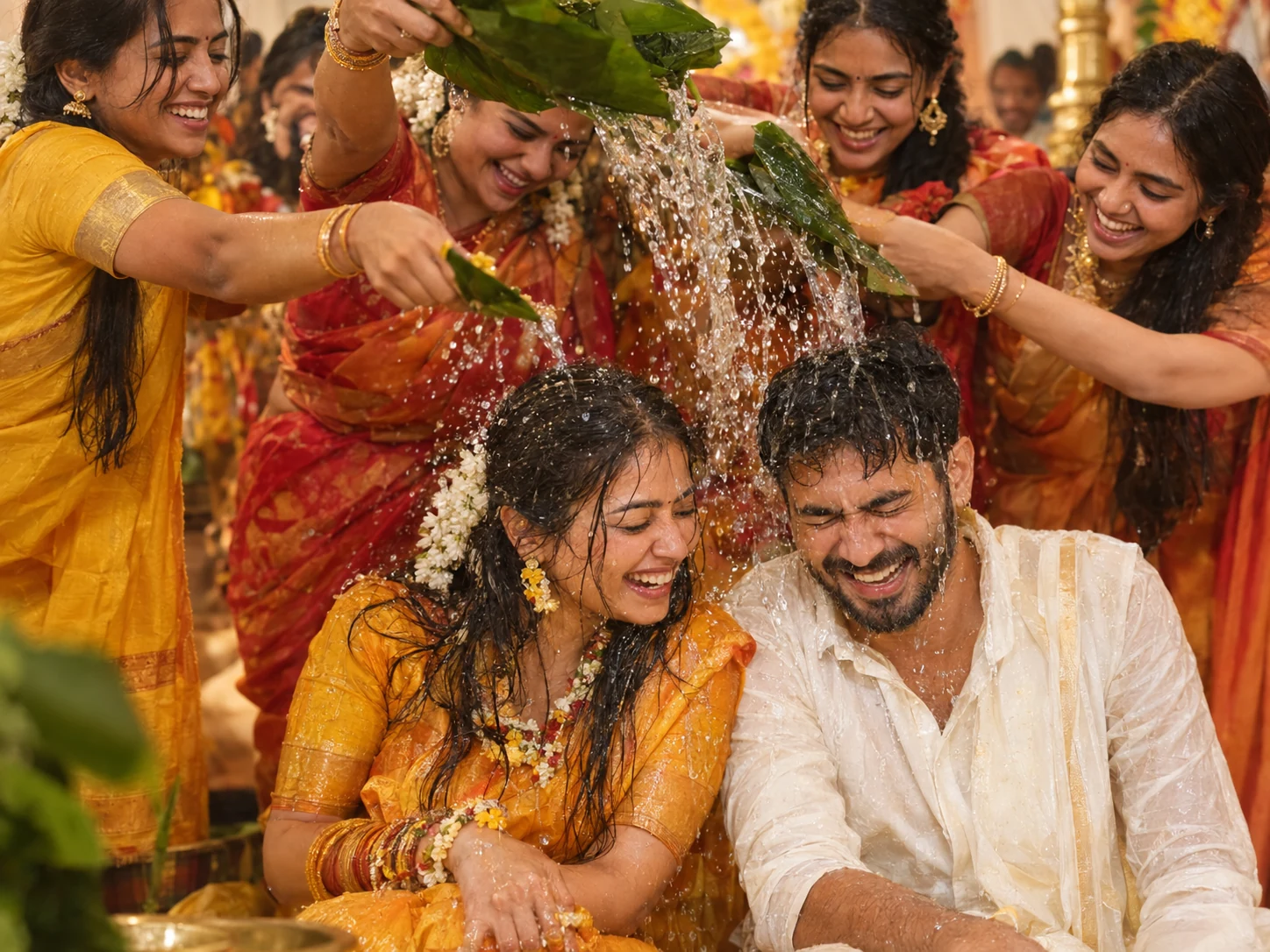
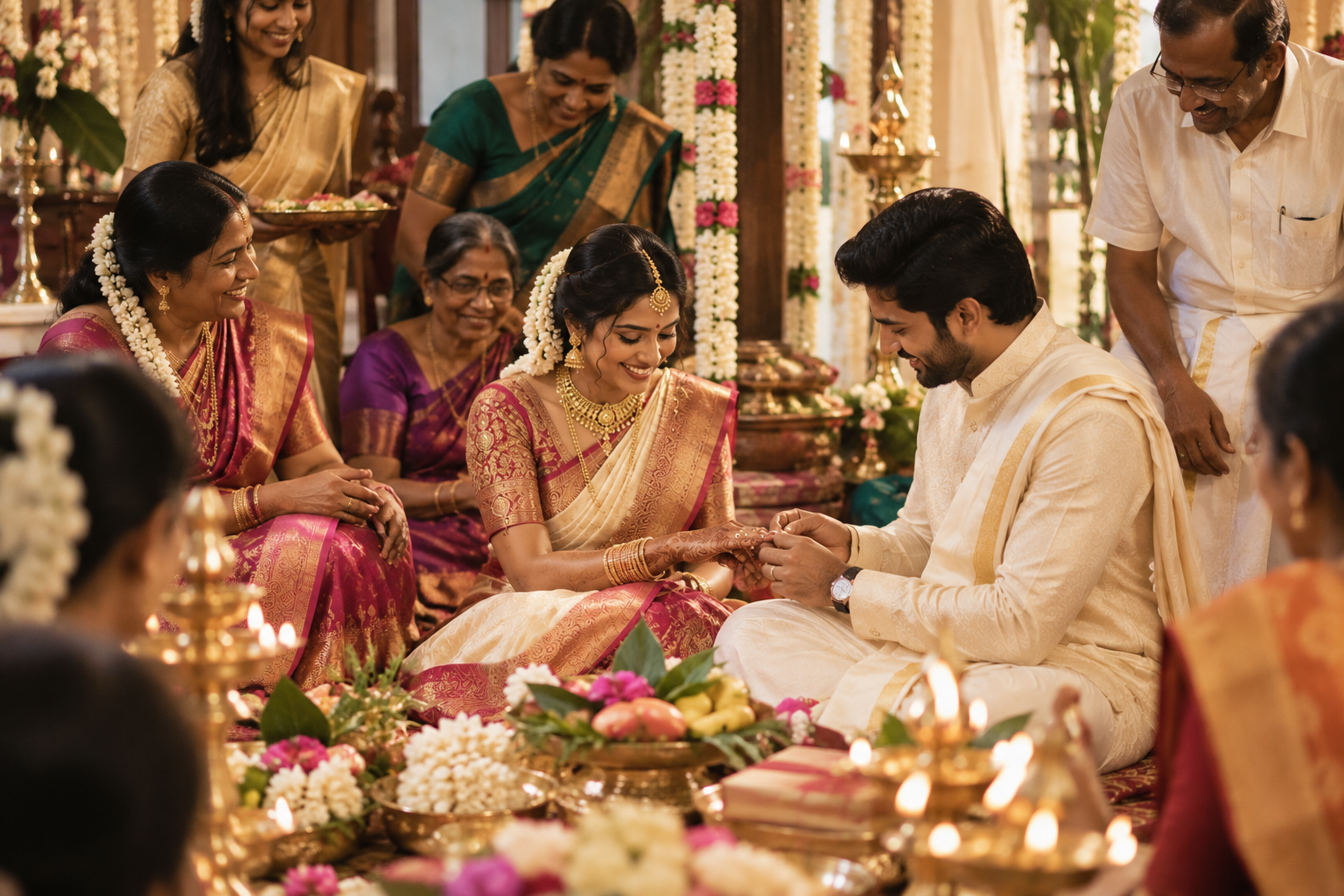
Often translated simply as engagement, Nichayathartham can carry a wider family meaning too: the forthcoming marriage is formally acknowledged, relatives gather, and the two families come together around the couple they are preparing to celebrate.
Depending on family tradition, there may be thamboolam, blessings, prayers, gifts or other ceremonial exchanges. For couples today, there might also be rings, flowers, photography, a beautifully dressed stage and dinner with everyone they love.
One doesn't have to erase the other.
What is Nichayathartham?
Nichayathartham is the Tamil engagement or betrothal tradition: an occasion through which an intended marriage is formally acknowledged.
That makes it a little broader than thinking of an engagement only as a proposal followed by a ring.
In documented Tamil practice, the families and relatives matter too. Tamil cultural material records betrothal customs in which families come together and exchange thamboolam as part of confirming the marriage. Nichayathartham and Nichaya Thamboolam are among the terms associated with that confirmation.
For couples today, those layers can sit together beautifully.
There is the commitment between two people.
And then there is the moment when the people closest to them gather and say, in their own way:
“This wedding is happening.”
The moment a wedding becomes official
Most weddings begin long before the invitations.
There are conversations between the couple, conversations at home, introductions between families, possible dates, guest lists that somehow start growing before anyone has actually made one, and all the small decisions that happen quietly in the background.
Nichayathartham changes the feeling.
The marriage moves from private conversations into family celebration.
Tamil cultural documentation describes a related betrothal practice as a way of confirming the intended marriage among relatives. That helps explain why the English word engagement, while useful, doesn't always capture the whole feeling.
Nichayathartham can be more than announcing that two people intend to marry.
It can be the beginning of the wedding as a family occasion.
Nichayathartham, Nichaya Thamboolam & Parisam
Ask older relatives what they call the engagement and you may discover that everyone doesn't use exactly the same word.
Tamil cultural material describes பரிசம் போடுதல் (parisam poduthal) as a betrothal-related practice involving relatives and an exchange of thamboolam. In the practice documented there, confirming the marriage is also referred to as Nichayathartham or Nichaya Thamboolam.
That doesn't mean every Tamil family uses all three terms interchangeably.
The language itself may carry family and community history.
So before the signage is ordered and NICHAYATHARTHAM appears in enormous gold lettering, ask one simple question:
“What have we always called this at home?”
The answer might tell you more about your celebration than a moodboard ever could.
What happens at a Nichayathartham?
There isn't one checklist we'd give every Tamil couple.
The cultural centre is fairly simple: a marriage is being formally acknowledged.
What surrounds that moment depends on the families involved.
You may encounter an exchange between the families, thamboolam, blessings, prayers, gifts or new clothes. Some engagements include rings. Some include a more explicitly religious ceremony. Some are intimate family occasions; others lead straight into a large reception.
Instead of asking:
“What are the mandatory Nichayathartham rituals?”
start with:
“What makes the engagement official in our families?”
That gives you something much more useful to plan around.
The exchange between families
One tradition particularly worth understanding is thamboolam.
Tamil cultural sources document its exchange in connection with confirming a marriage, and the term Nichaya Thamboolam itself reflects that relationship.
Exactly what families prepare can vary.
Rather than downloading a checklist of supposedly compulsory engagement trays, ask both sides what they actually exchange, who prepares it and whether anything has changed since earlier family weddings.
The answer may be beautifully elaborate.
It may be wonderfully simple.
Either way, it's yours.
And what about the rings?
For many couples today, this may be the moment everyone is waiting to photograph.
The rings appear. The phones come up. Someone asks the couple to hold their hands together for one more photograph.
There is nothing strange about including that in a contemporary Nichayathartham.
But a ring doesn't need to become the defining historical ritual of Tamil engagement simply because modern engagements commonly include one. The Tamil material we're relying on gives greater emphasis to confirming the marriage and the relationship between the families.
So if rings are part of your celebration, enjoy them.
If they aren't part of your family's tradition, you don't need to add them merely to make the occasion look recognisably like an engagement.
Tradition and contemporary celebration don't have to compete.
When is Nichayathartham celebrated?
Nichayathartham belongs before the marriage, but there isn't one interval every family follows.
Today, many couples may choose to make the engagement its own celebration well ahead of the wedding.
Other traditions place the formal betrothal much closer to the marriage. Tamil cultural material documents related betrothal practice taking place on an auspicious day before the marriage or on the day immediately preceding it.
The practical lesson is simple:
Don't move your family's engagement because an online timeline says:
“Six months before the wedding.”
Find out where it belongs in your tradition first.
Then build the planning calendar around the wedding you're actually having.
A note about the Pathirikai
Some Tamil families may also know a Nischayathartha Pathirikai or related written marriage announcement.
Where it forms part of family tradition, it can record or formally communicate details surrounding the forthcoming marriage.
But do not present it as a universal Nichayathartham requirement.
If the term is familiar at home, this is one of those lovely opportunities to ask:
“Do we still have one from an older family wedding?”
An old document may reveal names, wording and family details that no generic engagement guide could give you.
And if nobody at home recognises the term, there is no missing box you need to tick.
Nichayathartham in Malaysian Tamil families
For Malaysian Tamil couples, engagement traditions can sit somewhere between what previous generations carried with them and the way families celebrate weddings here today.
Research conducted within an Indian community in Sekinchan, Selangor found that some traditional wedding practices had changed or become simpler in contemporary life while continuing to maintain links with inherited cultural traditions.
It was a small, community-specific study—not a description of every Malaysian Tamil family—but that relationship between continuity and change is useful to think about.
Your parents may remember an engagement held at home.
Yours might be in a hotel or hall.
Your family may keep a traditional exchange while you add rings, professional photography and an evening reception.
The couple may now make styling and planning decisions that earlier generations left largely to relatives.
None of those changes automatically tells us whether a celebration is “traditional enough.”
A better question is:
“Which parts carry meaning for our families, and which parts are we choosing for ourselves?”
And as with all Riya Invites coverage in Malaysia, do not turn that into one generic “Malaysian Indian engagement.”
Malaysian Tamil, Telugu, Malayalee and other Indian communities have their own terminology, family histories and wedding practices. They deserve to be understood on their own terms.
Two families, one celebration
Nichayathartham has a strong family dimension in documented Tamil practice.
For couples today, that doesn't have to diminish the relationship at the centre of it.
Two people are choosing a marriage.
And two families are learning how they will celebrate it together.
That becomes especially meaningful when each side arrives with slightly different expectations.
One family may expect rings.
The other may care most about the traditional exchange.
One may expect a prayer.
The other may have always kept the engagement informal.
Those differences are easier to navigate before everyone is dressed and waiting for the ceremony to begin.
Ask each family what matters to them.
Then decide together what belongs in yours.
What to wear for Nichayathartham
An engagement gives you wonderful room to dress beautifully without making it feel like a preview of the wedding itself.
For a bride, silk can make the occasion feel immediately special. A richly woven saree works beautifully for a formal engagement, while a softer or lighter saree can suit a daytime or more intimate celebration.
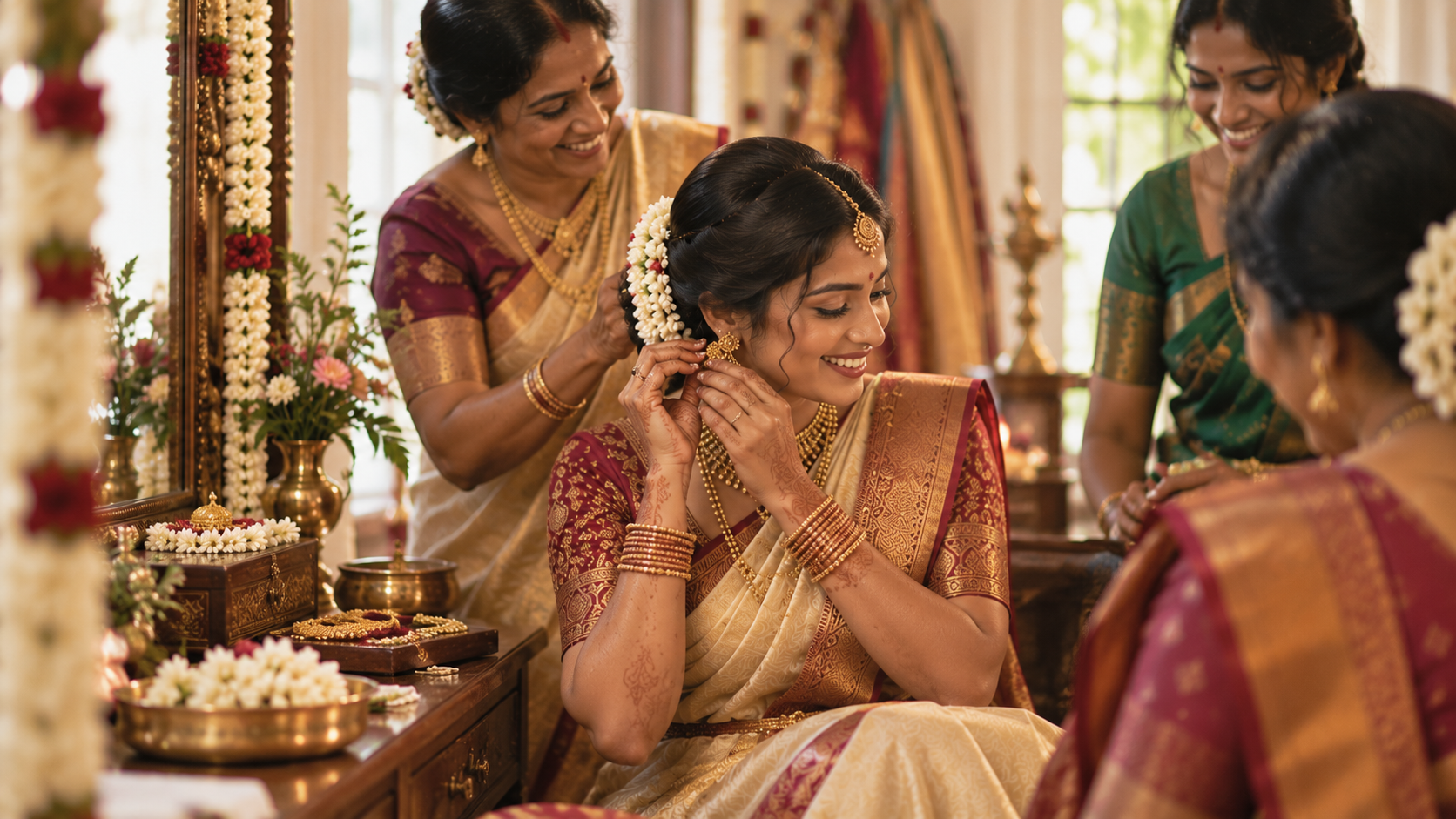
The jewelry can follow the mood. Traditional gold has an effortless place here; temple-inspired pieces, delicate layers or a more restrained heirloom look can all work depending on the saree and setting.
Jasmine woven into the hair can bring softness and familiarity to the look without requiring the scale of full wedding-day styling.
For the groom, a crisp veshti and shirt can feel timeless where it suits the family's celebration. A kurta or other Indian formalwear can take the look in a more contemporary direction, while a suit may fit an evening reception beautifully.
The useful question isn't:
“What are you supposed to wear to Nichayathartham?”
It's:
“How do we want this celebration to feel different from the wedding?”
Let the engagement have its own visual identity.
Save something for the wedding day.
Setting the scene
Before choosing a backdrop, think about what will happen in front of it.
Will the families exchange thamboolam?
Will parents or elders be beside the couple?
Will there be prayers?
Will rings be exchanged?
Does anything need to be placed, carried, opened or presented?
Design the space around those moments first.
Then make it beautiful.
For a Riya Invites engagement mood, imagine layers rather than spectacle: jasmine and soft florals, polished brass where appropriate, silk textures, elegant trays, warm ivory, antique gold, terracotta, deep green or jewel-toned accents.
A stage doesn't need to be covered from floor to ceiling in flowers to feel luxurious.
Sometimes one beautiful textile, thoughtful lighting and enough breathing room for the families to actually participate will photograph far better.
And if the couple's parents have engagement photographs of their own, encourage them to look at those before Pinterest.
There may be a colour, flower, piece of jewelry or tiny family detail worth bringing back.
Photograph the story, not only the rings
Of course, photograph the rings if they're being exchanged.
But the photographer should know what else matters.
The hands preparing thamboolam.
A parent straightening an outfit.
An elder waiting to bless the couple.
The expression on someone's face when the formal part becomes official.
Siblings hovering just outside the frame.
The first photograph where both families somehow manage to look at the same camera.
Those are the images that explain what Nichayathartham really felt like.
The engagement isn't only a portrait session before the wedding.
It's a story about a marriage becoming visible to everyone around it.
Planning your Nichayathartham
Before booking décor packages or ordering personalised trays, sit down with both families.
Not because the couple shouldn't make the decisions.
Because understanding the family tradition first makes those decisions much easier.
Questions worth asking
- What do we call the ceremony?
- Nichayathartham, Nichaya Thamboolam, Parisam—or another family term?
- What makes the engagement official for us?
- An exchange, blessing, announcement, prayer or another family practice?
- Who needs to participate?
- Parents, elders, relatives, a priest—or a different combination?
- What do the families exchange?
- Get the real list before ordering the trays.
- Are rings part of our engagement?
- Confirm whether they belong in the celebration you are planning.
- Is there a Pathirikai or written announcement in our tradition?
- Ask whether your family recognises or still uses one.
- Will the wedding date or muhurtham be shared?
- Confirm this with both families rather than assuming.
- Are prayers or religious elements involved?
- Identify what your family expects and who will guide it.
- What should the photographer know?
- List the people, exchanges and quiet moments that matter.
- What does one family do differently from the other?
- That final question may save the most trouble.
Differences are much easier to celebrate when nobody discovers them five minutes before the ceremony.
Traditional engagement or modern party?
Why choose?
A Nichayathartham can keep the pieces families value while still feeling completely contemporary.
The traditional portion might be intimate, followed by dinner with a larger guest list.
The families might exchange thamboolam while the couple exchanges rings.
The couple might wear silk for the ceremony and change for the reception.
They might celebrate at home with twenty people or host an evening engagement with two hundred.
The scale isn't what makes the tradition meaningful.
Knowing what you're carrying forward is.
Good to know before your Nichayathartham
Is Nichayathartham the same as an engagement?
Engagement is the clearest English shorthand, but Nichayathartham can include a stronger ceremonial and family dimension than the modern idea of a proposal followed by rings.
Do we have to exchange rings?
No universal Tamil requirement establishes rings as the defining act. They're a natural part of many contemporary engagements, but family tradition should guide whether they belong in a particular celebration.
Does Nichayathartham have to be months before the wedding?
No. Timing varies. Documented Tamil betrothal practice includes ceremonies held close to the marriage as well as before it.
Do we need a priest?
That depends on the family's tradition. Some forms include explicitly religious elements or priestly participation; do not turn that into a requirement for every Tamil engagement.
Are Nichayathartham, Nichaya Thamboolam and Parisam the same?
They're connected in Tamil cultural documentation, but family and community usage can differ. Encourage readers to ask what those names mean within their own tradition rather than assuming they're universally interchangeable.
Do we need a Pathirikai?
Not as a universal requirement. Written engagement or marriage announcements belong to particular family/community traditions rather than something to prescribe for every Nichayathartham.
Can we combine family tradition with a modern engagement party?
Absolutely. Start by understanding which elements carry family meaning. Everything around them—styling, photography, dinner, music and the scale of the celebration—can become the couple's own.
A promise made visible
There is something lovely about an engagement precisely because the wedding hasn't happened yet.
Everything is still ahead.
The outfits haven't all been chosen. The guest list may still be changing. The invitations might exist only as a conversation. There will be budgets to balance, ceremonies to organise and approximately a thousand family WhatsApp messages before anyone reaches the wedding day.
But Nichayathartham gives all that anticipation a moment.
Two people know they are getting married.
Their families gather around them.
The marriage is acknowledged.
And suddenly the wedding isn't an idea anymore.
It has begun.
How we researched this guide
Riya Invites researches wedding traditions through Tamil-language cultural and educational material, lexicographic sources, academic research, community documentation and contemporary wedding practice.
For this guide, Tamil Virtual Academy material was particularly useful because it documents parisam poduthal as a betrothal-related practice involving relatives and thamboolam, and connects the confirmation of the marriage with the terms Nichayathartham and Nichaya Thamboolam. That source describes a particular folk-cultural context, so its exact sequence is not treated here as a universal Tamil engagement ceremony.
For the Malaysian context, we consulted academic research on wedding practices within an Indian community in Sekinchan, Selangor. The study used four in-depth informants, observation and secondary material and found both changes in contemporary practice and continuity with inherited traditions. Its findings are useful context, not a template for every Malaysian Tamil family.
Where family or community sources document details such as a Nischayathartha Pathirikai, Riya Invites treats those as examples rather than requirements.
Selected sources
- Tamil Virtual Academy — Life-cycle rituals / Parisam Poduthal. Used for parisam poduthal, thamboolam, marriage confirmation and the relationship between Nichayathartham and Nichaya Thamboolam terminology.
- Jurnal Kinabalu — Marriage Customs and Practices among the Indian (Tamil) Community in Sekinchan, Selangor. Used only for Malaysian context concerning continuity and contemporary change.