
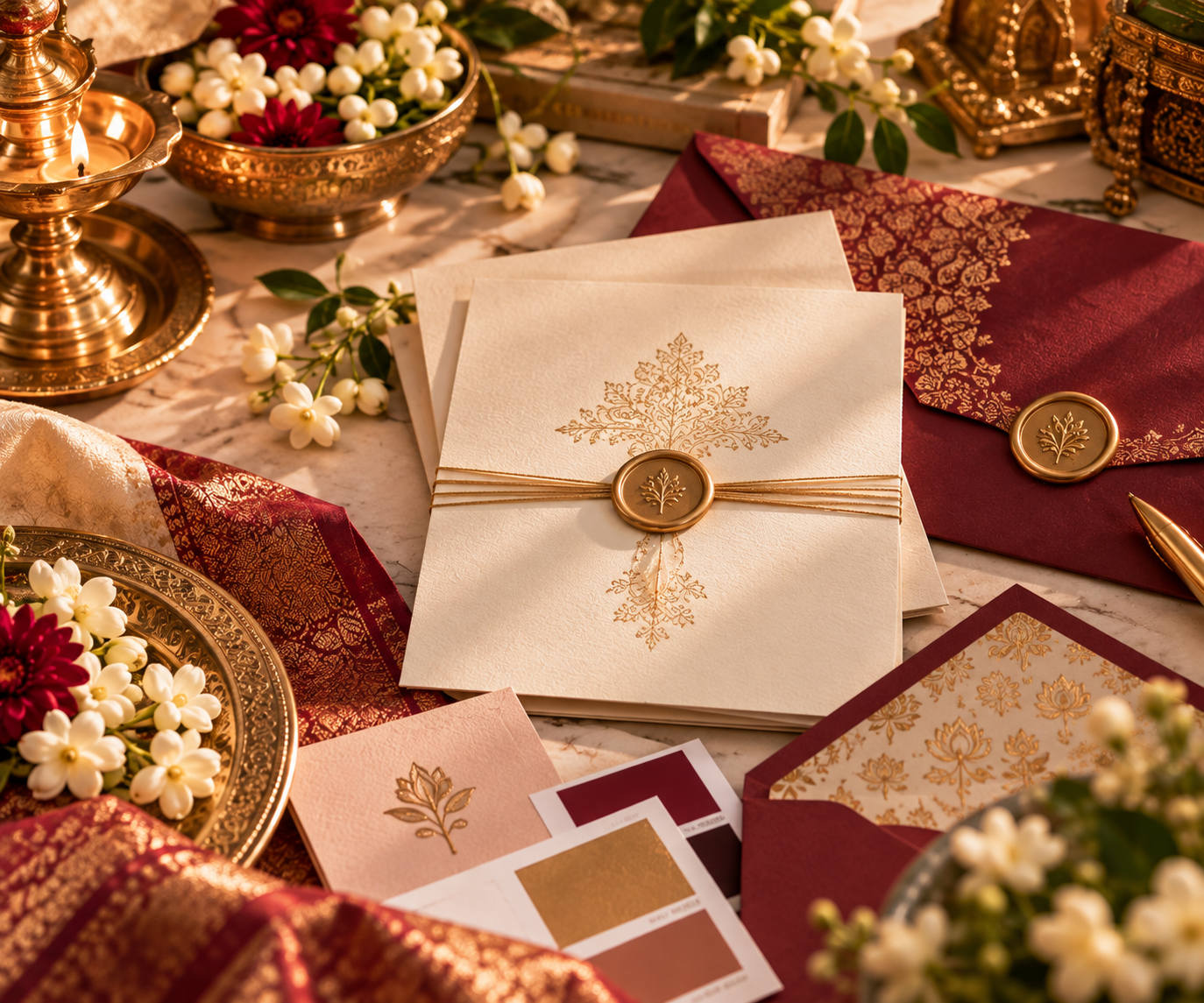
A wedding invitation has a surprisingly difficult job.
It needs to tell your guests where to be and when.
It may need to introduce two families, acknowledge parents or grandparents, explain several celebrations, communicate cultural or religious details and make sure nobody is left wondering what they are actually invited to.
And it has to do all of that while still feeling beautiful.
For Indian weddings, where celebrations may involve several ceremonies and different groups of guests, invitation wording can become particularly detailed.
Should the parents' names appear first?
Do you include titles?
How do you word an invitation when both families are hosting?
Should every ceremony appear on one card?
What happens when some guests are invited to the wedding but not the reception?
And how much information is simply too much?
There isn't one wording formula that every couple needs to follow.
Indian wedding invitation traditions can vary between families, communities, religions and individual preferences. A traditional family may prefer formal wording and prominent acknowledgement of parents, while another couple may choose something much simpler and contemporary.
The best invitation respects the people and traditions that matter to you while making the celebration completely clear to your guests.
Here's how to build one.
1. Start With the People Hosting the Wedding
Traditional wedding invitations often begin with the people extending the invitation.
In many families, this may be the couple's parents.
Mr & Mrs [Parent Names]
request the pleasure of your company
at the wedding of their daughter
[Bride's Name]
to
[Groom's Name]
son of Mr & Mrs [Parent Names]
But this is only one structure.
If both families are hosting together, the invitation can acknowledge both families equally:
Together with their families
[Name] & [Name]
invite you to celebrate their wedding
Or:
The families of [Name] and [Name]
warmly invite you to celebrate
the marriage of their children
A couple hosting the celebration themselves may simply begin with their own names.
The important question isn't Which format is technically correct?
It is:
Who does your family want the invitation to recognise as hosting or inviting the guests?
Decide that before trying to perfect the rest of the wording.
2. Decide How Family Names Should Appear
Names can be one of the most sensitive parts of an invitation.
Before designing anything, confirm exactly how each person's name should be written.
That includes:
- spelling;
- initials;
- titles;
- surnames;
- preferred order;
- parents' names;
- grandparents' names where included;
- honorifics where relevant.
Do not rely on memory.
Ask.
This becomes even more important when names will appear in more than one language or script.
If both families want to review the wording, establish one final approved version before the invitation moves into production.
A tiny spelling correction is easy in a document.
It is much less tiny after hundreds of invitations have been printed.
3. Include the Essential Wedding Details
Beautiful wording should never make essential information difficult to find.
At minimum, guests should be able to identify:
- who is getting married;
- what celebration they are being invited to;
- the date;
- the start time;
- the venue;
- the location or address where necessary.
If there are important arrival instructions, include them clearly.
For a religious ceremony, you may also need to communicate information such as appropriate arrival time, venue etiquette or other practical expectations.
Keep the hierarchy obvious.
Your guests should not have to read an entire paragraph to discover what time the ceremony begins.
4. Be Clear About Which Event the Guest Is Invited To
A Malaysian Indian wedding may involve several celebrations.
Depending on the couple and family, these might include an engagement or Nichayathartham, pre-wedding ceremonies, the wedding ceremony, reception or other family and religious events.
Not every guest will necessarily attend every event.
Your invitation needs to make that distinction clear.
If the same guests are invited to everything, one invitation suite can present the celebrations together.
If guest lists differ, separate cards or separate digital invitations may be clearer.
For example:
Wedding Ceremony
Saturday, 12 September 2027
9:30 in the morning
Sri ______ Temple
Kuala Lumpur
and:
Wedding Reception
Saturday, 12 September 2027
7:00 in the evening
Grand Ballroom
______ Hotel, Kuala Lumpur
If a guest is invited only to one of those celebrations, send information relevant to that invitation rather than creating ambiguity.
Clear wording is kinder than leaving guests to guess.
5. Traditional Wording Can Still Feel Personal
Formal wording doesn't have to sound cold.
A traditional invitation can acknowledge family and culture while still sounding warm.
For example:
With the blessings of our parents and families,
we joyfully invite you to celebrate
the marriage of
[Name]
and
[Name]
Or:
With the blessings of our families,
[Name] & [Name]
request the pleasure of your company
as they begin their life together.
If a religious blessing, quotation or traditional phrase is meaningful to your family, it can be incorporated thoughtfully.
The invitation doesn't need to sound like everybody else's simply because the structure is traditional.
6. Modern Wording Can Still Respect Tradition
Contemporary couples sometimes worry that simple wording will appear disrespectful.
It doesn't have to.
You can retain the people and cultural details that matter while making the language more relaxed.
For example:
Together with our families,
we're getting married.
[Name] & [Name]
We would love for you to celebrate with us.
Or:
Two families. One celebration.
Join [Name] & [Name]
as we celebrate the beginning
of our next chapter together.
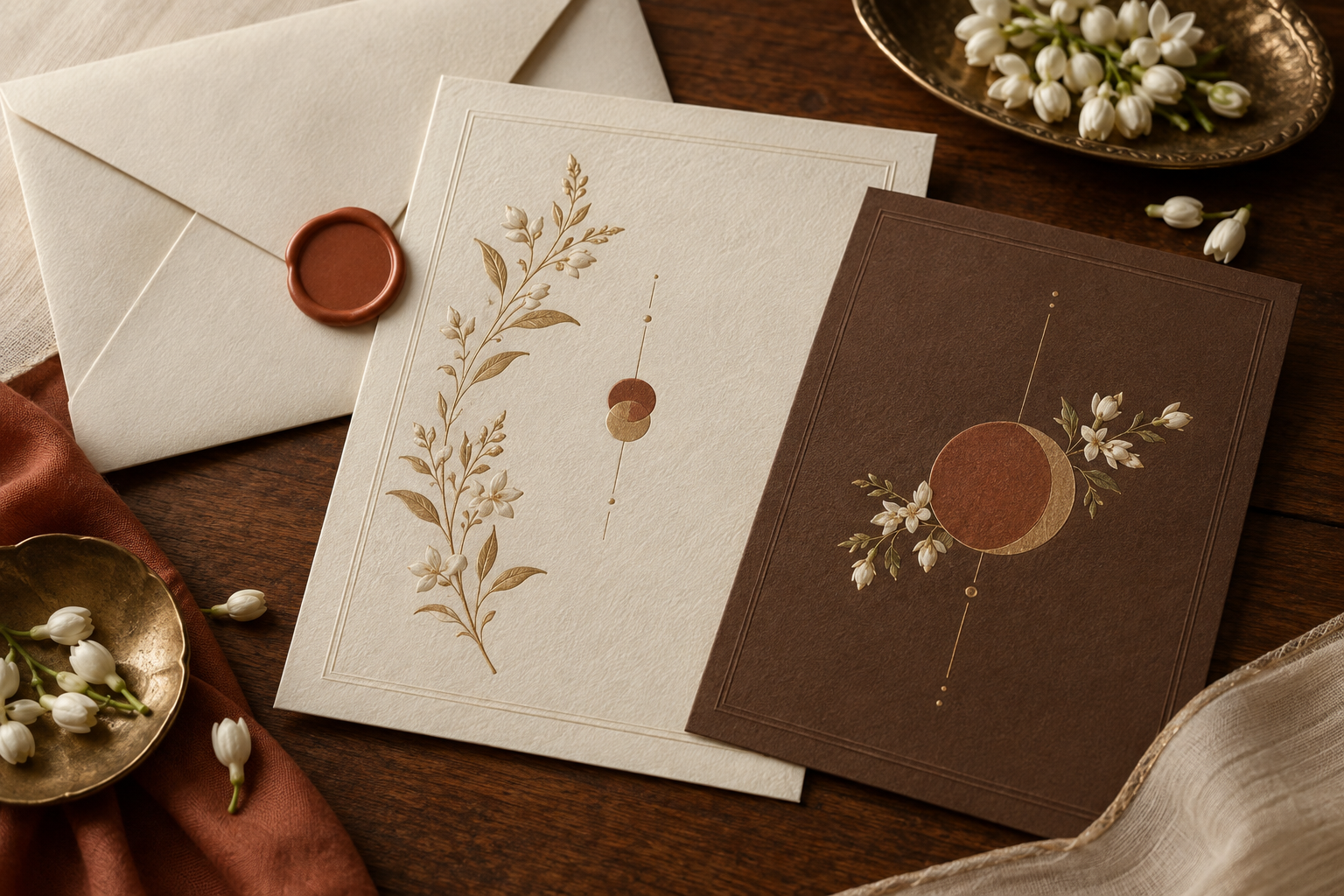
The design can then carry some of the formality through typography, colour, motifs and materials.
Traditional and modern are not opposites.
A wedding invitation can contain elements of both.
7. Think Carefully About Bilingual Invitations
For some Malaysian Indian families, presenting wedding information in more than one language may be meaningful or practical.
That could mean English alongside Tamil or another language relevant to the families.
Before choosing a bilingual format, think about how much information needs to appear.
Simply duplicating every line can quickly make an invitation feel crowded.
Possible approaches include:
- both languages presented together on the main invitation;
- one language on each side;
- separate inserts;
- a primary invitation with additional digital information;
- selected ceremonial or family wording in one language while practical details remain in another.
Whichever approach you choose, accuracy matters.
Names, dates, religious terminology and ceremonial wording should be checked by someone who is genuinely comfortable with the language.
A bilingual invitation should feel intentionally designed in both languages—not like one version was added after the other was finished.
8. Give Religious and Cultural Details Room to Breathe
Indian wedding invitations can contain culturally significant elements beyond the basic event information.
Depending on the family and ceremony, this might include a religious symbol, blessing, invocation, traditional motif, auspicious timing or ceremonial terminology.
These details can be beautiful and meaningful.
They also deserve space.
Trying to fit every possible symbol, quotation and piece of information onto one card can make the invitation harder to understand.
Choose what matters.
If a particular religious element is important to your family, allow it to have visual significance rather than surrounding it with competing decoration.
And when you're unsure about the correct terminology or religious convention, confirm it with the appropriate family member, priest or religious representative rather than relying on a generic template.
9. Decide What Belongs on the Main Invitation—and What Doesn't
Not every wedding detail needs to appear on the main card.
The main invitation should usually carry the most important information.
Additional details can be placed on an insert, accompanying card, wedding website or digital message.
These might include:
- RSVP instructions;
- dress guidance;
- maps or directions;
- parking information;
- accommodation information;
- additional ceremony details;
- contact numbers;
- gift information where appropriate;
- transport arrangements.
This creates breathing room.
It also means practical information can be updated more easily if something changes.
Think of your invitation as a small information system rather than one card that has to carry the entire wedding.
10. Make RSVP Instructions Easy to Follow
If you need guests to respond, tell them exactly how.
For example:
Kindly RSVP by 1 August 2027
[Name] — [contact method]
Or:
Please confirm your attendance by 1 August 2027.
For digital invitations, the RSVP may link directly to a form or another response method.
Whatever system you choose, keep it simple.
If you need responses separately for the ceremony and reception, make that clear.
And give yourself enough time between the RSVP deadline and the wedding to follow up with guests who haven't replied and provide final numbers to your venue or caterer.
11. Printed or Digital? You Don't Necessarily Have to Choose
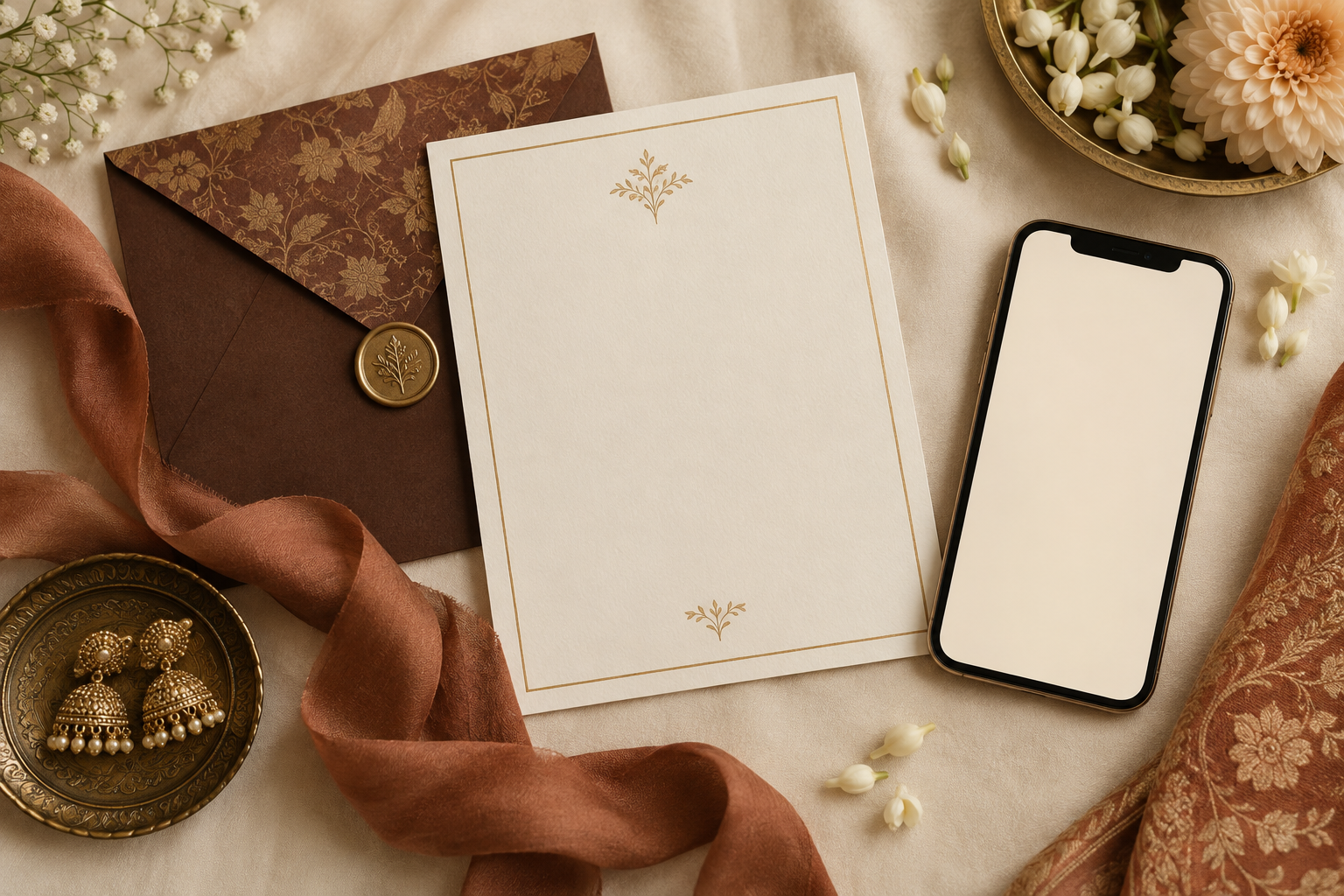
Printed and digital wedding invitations serve different purposes.
A printed invitation has physical presence.
It can feel ceremonial, personal and keepsake-worthy.
It may also be preferred by parents, grandparents or particular groups of guests.
A digital invitation is easy to distribute, particularly when guests live in different places. It can also make maps, contact information and updates easier to share.
Many couples don't need to choose one or the other.
A hybrid approach can work beautifully.
You might send printed invitations to close family and elders while using a coordinated digital version for a wider guest list.
Or use the printed invitation as the formal announcement and digital communication for reminders and practical information.
The important thing is consistency.
Both versions should feel like they belong to the same wedding.
12. Match the Invitation to the Wedding You're Planning
Your invitation doesn't need to reveal every décor detail.
But it should feel connected to the celebration.
A formal temple wedding may lead to one visual direction.
A modern ballroom reception may suggest another.
A colourful multi-day celebration may invite something completely different.
Think about:
- colour;
- typography;
- illustration;
- traditional motifs;
- florals;
- monograms;
- paper and finishing;
- photography where appropriate;
- overall formality.
Trends can provide inspiration.
They shouldn't erase your own story.
When someone receives the invitation, it should feel like the beginning of your wedding—not simply a beautiful template with your names added to it.
13. Proofread More Than Once
Before approving your wedding invitations, stop looking at the design for a moment and read them purely as information.
Check:
- every name;
- every title;
- spelling;
- dates;
- days of the week;
- ceremony times;
- venue names;
- addresses;
- RSVP dates;
- contact information;
- punctuation;
- religious or ceremonial terminology.
Then ask someone else to check.
Ideally, have a person from each family review any names or family information relevant to them.
For bilingual invitations, proofread both language versions independently.
And don't only ask:
“Does this look right?”
Ask:
“If I knew nothing about this wedding, would I know exactly where I needed to be and when?”
That's a much better test.
14. Common Wedding Invitation Mistakes to Avoid
Some invitation problems are aesthetic.
The more frustrating ones are practical.
Try to avoid:
- Too much information on one card.
- Important details become difficult to find.
- Tiny text because everything has been squeezed in.
- An invitation isn't successful if guests struggle to read it.
- Unclear event names.
- Guests should know whether they're attending the wedding ceremony, reception or another celebration.
- Assuming everybody knows the venue.
- Use the proper venue name and provide additional location information where necessary.
- Sending the design to print without final family approval.
- Especially when family names or traditional wording are involved.
- Using a beautiful font that makes names or details difficult to read.
- Legibility still matters.
- Copying wording without checking whether it suits your family.
- A template is a starting point, not a rule.
- Forgetting that plans can change.
- Keep information that may still change off permanently printed pieces where possible.
Wedding Invitation Wording Examples
There is no single script every couple needs to follow.
These examples are starting points that can be adapted to your family, ceremony and preferred level of formality.
Traditional family-led invitation
With the blessings of the Almighty
and our beloved families,
Mr & Mrs [Parents' Names]
request the pleasure of your company
at the wedding of their daughter
[Name]
with
[Name]
son of Mr & Mrs [Parents' Names]
on [Day, Date]
at [Time]
[Venue]
[Location]
Tamil wedding invitation wording example
Tamil wedding invitation wording can vary significantly between families and religious traditions.
The following is a simple, adaptable example rather than a prescribed traditional formula.
இறைவன் அருளுடனும்
இரு குடும்பத்தினரின் ஆசிகளுடனும்
[மணமகள் பெயர்]
&
[மணமகன் பெயர்]
இவர்களின் திருமண விழாவில்
தாங்கள் குடும்பத்துடன் கலந்து கொண்டு
மணமக்களை வாழ்த்தி அருளுமாறு
அன்புடன் அழைக்கின்றோம்.
நாள்: [கிழமை, தேதி]
நேரம்: [நேரம்]
இடம்: [திருமண மண்டபம் / ஆலயத்தின் பெயர்]
[இடம்]In English, the sense of this wording is:
With the grace of God and the blessings of both families, we warmly invite you and your family to join the wedding celebration of [Bride's Name] & [Groom's Name] and bless the couple.
A note on Tamil wording
Tamil wedding invitations can be considerably more formal than the example above, particularly when they include parents' names, grandparents, religious invocations, auspicious timing or traditional terminology. There can also be differences in preferred wording between families and communities.
For that reason, don't treat a generic Tamil template as automatically correct for your wedding. Have the final wording—especially names, religious phrases and ceremonial terminology—reviewed by family members or someone knowledgeable in the traditions being followed.
Both families hosting
The families of [Name] and [Name]
joyfully invite you to celebrate
the marriage of their children
[Name] & [Name]
on [Day, Date]
at [Time]
[Venue]
[Location]
Couple-led contemporary wording
Together with our families,
we invite you to celebrate our wedding.
[Name] & [Name]
[Day, Date]
[Time]
[Venue]
[Location]
We can't wait to celebrate with you.
Ceremony and reception on the same invitation
With the blessings of our families,
please join us for the wedding of
[Name] & [Name]
Wedding Ceremony
[Day, Date] · [Time]
[Ceremony Venue]
Reception
[Day, Date] · [Time]
[Reception Venue]
We would be honoured to celebrate with you.
Simple digital invitation
We're getting married!
[Name] & [Name]
Join us as we celebrate with our families
on [Day, Date] at [Time].
[Venue]
[Location]
Please RSVP by [Date]
[RSVP details]
These examples should be adapted rather than copied automatically.
Names, family acknowledgement, religious wording and ceremony terminology should reflect the people whose wedding the invitation actually represents.
Before You Approve the Final Invitation
There is one final check worth making.
Put the design aside and ask whether the invitation does these three things:
Does it honour the people who matter?
Does it clearly explain the celebration?
Does it feel like the wedding you're about to have?
If it does, the invitation is doing much more than announcing a date.
It's opening the door to the celebration.
Riya Invites
Your Wedding Story Begins Before the Wedding Day
Long before the flowers are arranged, the outfits are worn and your guests arrive, they receive something from you.
An invitation.
For some guests, it will be the first time your wedding feels real.
That's why at Riya Invites, we don't see wedding invitations as simply a place to put names, dates and venue details.
They are an introduction to everything that follows.
Whether your celebration calls for something deeply traditional, quietly contemporary or somewhere beautifully between the two, your invitation should feel considered, personal and unmistakably yours.
Riya Invites—invitations designed for the celebration you're actually planning.
Begin a conversation with Riya Invites →