
Exactly what Nalangu looks like depends on the family celebrating it. Some Tamil families know it as part of the preparations before the wedding. Others associate the name with a more playful celebration involving the couple together. Turmeric and sandalwood appear in documented traditions; songs and games belong to others. Rather than forcing all of these into one version, it is more useful to understand Nalangu as a wedding tradition that families have carried in different ways.
Historical Tamil lexicography itself records a festive marriage form in which the bride and groom apply substances such as sandalwood to one another and play together.
And if your family's Nalangu looks different from the one you have seen at another wedding?
That may be part of the story.
What is Nalangu?
Nalangu (நலங்கு), also commonly written Nalungu, is a name found within Tamil wedding traditions—but that simple definition opens onto several different family practices.
In some homes, Nalangu belongs to the preparations leading into the wedding: a smaller, more intimate occasion involving the bride or groom and close family.
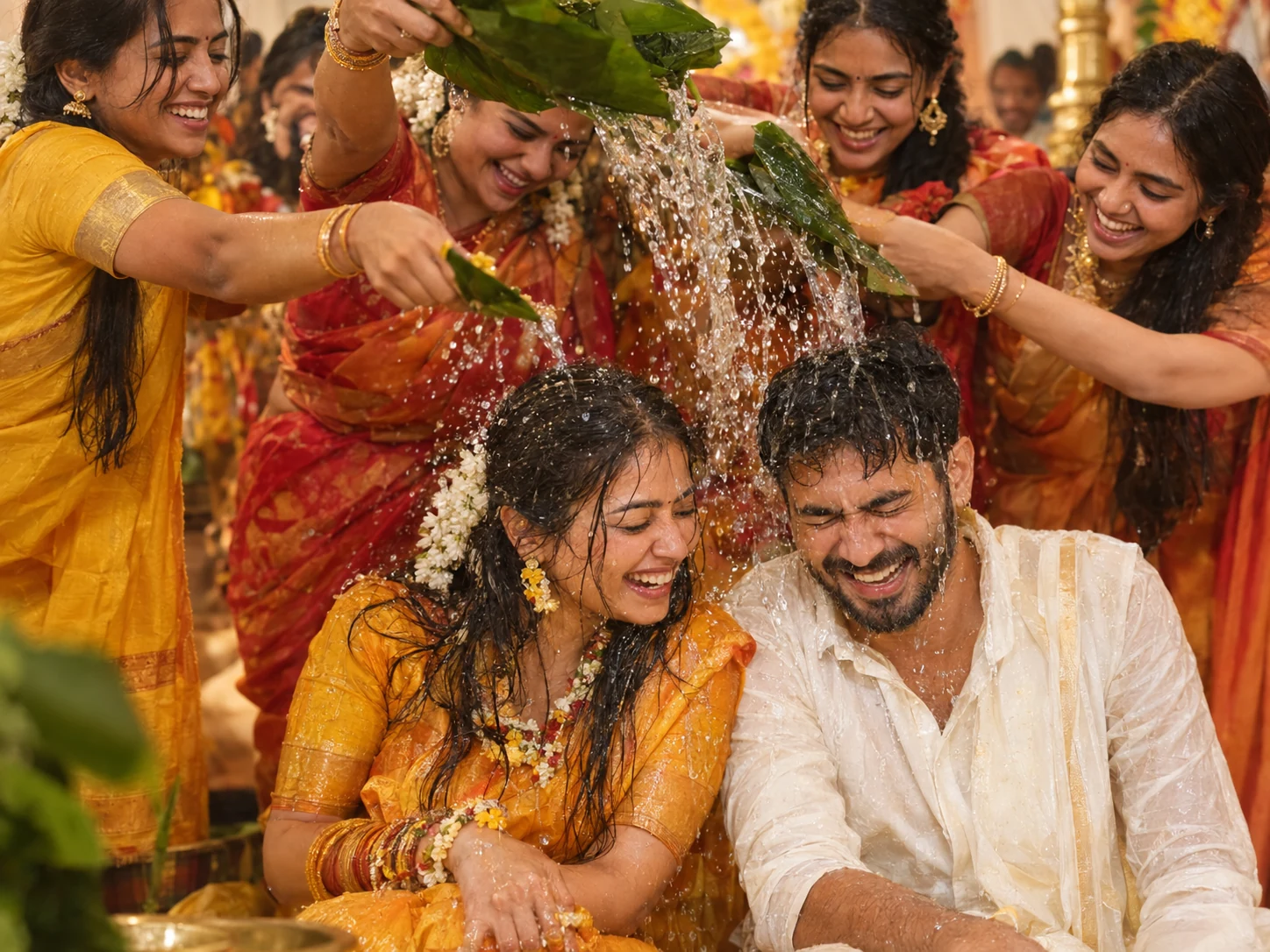
In other traditions, Nalangu brings the couple together and becomes one of the lighter moments surrounding the marriage, with relatives joining in and playful exchanges becoming part of the celebration.
Older Tamil dictionary material captures this second side particularly beautifully, defining nalaṅku as a marriage celebration in which the bride and groom apply sandalwood and other substances to one another and play together.
So when you're planning your own wedding, the most useful question may not be:
“What is the correct way to do Nalangu?”
It may be:
“How does our family celebrate it?”
That conversation is often where the real guide begins.
When is Nalangu celebrated?
This is one of the reasons Nalangu can become confusing when you search for it online: you may find completely different answers, and more than one can reflect a genuine tradition.
One family may describe Nalangu as a pre-wedding observance.
Another may remember the bride and groom sitting together around the wedding celebrations, surrounded by relatives, songs and games.
The difference is important.
It means you don't need to rearrange your family's Nalangu to fit an online wedding timeline.
Before fixing the date and time, ask parents, grandparents or the relatives who usually guide your family's ceremonies where Nalangu traditionally sits within your wedding celebrations.
What happens at a Nalangu?
This is where family tradition matters most.
There isn't a universal checklist we would recommend copying from the internet.
Instead, documented forms of Nalangu give us a collection of practices that may be familiar to some families and completely different from others.
Turmeric, sandalwood & the preparations for the celebration
Turmeric appears in documented forms of Nalangu and related pre-marriage preparations, as does sandalwood.
Historical Tamil sources also connect the term with fragrant substances and with the bride and groom applying sandalwood and other preparations to one another.
For a couple planning today, the important distinction is between recognizing these as part of documented traditions and declaring that every Nalangu requires the same ingredients.
If your family uses turmeric, sandalwood, oils, pastes or other preparations, ask an older relative how they are prepared, who applies them and at what point in the ceremony.
Those details are far more valuable than recreating a list found online.
When the family joins in
One of the loveliest things about a smaller wedding ceremony is how visible family becomes.
Rather than the couple being separated from everyone by the scale of the wedding day, Nalangu can bring relatives close: someone preparing what is needed, another person explaining what comes next, family members offering blessings, and everyone gathering around the celebration.
In some documented traditions, women in the family have a particularly visible role.
In others, the participants and responsibilities may be different.
If there are songs associated with your family's Nalangu, ask about those too.
These are exactly the details worth recording while the people who know them can still tell you the story.
When Nalangu becomes playful
Not every part of a wedding has to feel solemn.
Some traditions of Nalangu bring the bride and groom together for games and playful exchanges, with relatives watching, singing, teasing and joining the fun.
Historical Tamil lexicography explicitly includes play between the bride and groom in its marriage-related definition of Nalangu.
You may hear about coconuts being rolled between the couple, objects being searched for in a vessel, or other family games.
But this is an area where online guides often turn one community's practice into a universal “Nalangu games list.”
We wouldn't.
If games are part of your family's Nalangu, find out which ones belong to your celebration.
Ask older married couples what they remember doing.
You may discover that the stories surrounding the game are just as memorable as the game itself.
And if your family doesn't include games at all, nothing needs to be added simply to make the ceremony look like someone else's.
Nalangu in Malaysian Tamil weddings
For Malaysian Tamil couples, wedding traditions often live in a particularly personal place: somewhere between what has been carried through generations, what relatives remember, and how families celebrate in Malaysia today.
Malaysian heritage documentation gives us one useful recorded example.
A George Town community-based heritage project documented a Tamil practice called Nalenge / நலங்கு as a pre-wedding blessing and purifying ceremony.
The documented form involved family participation and preparations including turmeric and sandalwood.
It gives us evidence of Nalangu being practised within a Malaysian Tamil setting—but it represents that documented practice, not a rule for every Malaysian Tamil household.
That distinction matters because “Malaysian Indian wedding” isn't one ritual tradition.
Malaysian Tamil, Telugu and Malayalee families may carry different wedding customs, and there can be variation within each of those communities too.
For Riya Invites, Malaysia is therefore part of the story of Nalangu—not a reason to flatten it into one “Malaysian version.”
Is Nalangu the same as Haldi?
Not necessarily.
It's easy to see why the comparison happens.
Turmeric can appear in Nalangu, and the yellow-filled photographs associated with contemporary Indian pre-wedding celebrations can look familiar across traditions.
But similar ingredients do not automatically make two ceremonies interchangeable.
Some contemporary wedding sources describe Nalangu as the Tamil equivalent of Haldi.
Our broader research suggests that distinction needs more care: Tamil sources also document forms involving the couple together, sandalwood and play, rather than one universal turmeric-centered pre-wedding sequence.
So if your family calls the ceremony Nalangu, we'd keep that name.
It carries its own story.
What to wear for Nalangu
There isn't one Nalangu dress code—and this is where tradition and styling inspiration should stay separate.
Start with your family's ceremony.
Will you be sitting for a long period?
Will turmeric, sandalwood, oil or another preparation be applied?
Is the occasion intimate at home, or are you hosting a larger celebration?
Does your family expect particular attire?
Once you know that, you can have fun with the look.
For a bride, a silk or lightweight saree can create a beautiful traditional silhouette; depending on the formality of the occasion, other Indian outfits may work just as well.
Jasmine, gold jewelry and warm textiles can bring richness without making the styling feel overdone.
For the groom, traditional Tamil attire such as a veshti can suit the occasion beautifully where it fits the family's expectations.
And if turmeric or other substances will actually be applied, practicality matters.
This may not be the moment for the outfit you are most afraid to mark.
Décor for a Nalangu
A Nalangu doesn't need to become a yellow-themed event simply because turmeric is involved.
Instead, start with the setting.
If you're celebrating at home, that intimacy can be part of the beauty.
Flowers, brass details, textiles and a thoughtfully prepared seating area may be all the visual language you need.
For a larger venue celebration, you can build from the same idea rather than transforming the occasion into a generic pre-wedding set.
Consider:
- jasmine and other flowers meaningful to your family or design
- brass lamps and vessels where appropriate
- woven mats or textiles
- kolam-inspired details
- warm ivory, turmeric, terracotta and green tones rather than a single saturated yellow
- comfortable seating with enough room for relatives to participate
- lighting that allows both the ceremony and the people around it to be photographed naturally
The best décor should frame what is happening, not compete with it.
Planning your Nalangu
Before you make a moodboard or send anything to a decorator, talk to your family.
You don't need a formal research session.
Sit down with the people who know the ceremony and ask them to walk you through it.
Questions worth asking
- What do we call it?
- Nalangu, Nalungu or another name or pronunciation?
- When do we celebrate it?
- Before the wedding, around the wedding day, or at another point?
- Who guides the ceremony?
- And which relatives traditionally participate?
- What needs to be prepared?
- Ask for the actual family list rather than assuming an online one.
- Are there songs or games?
- If so, who remembers them?
- What should we wear?
- Especially if substances will be applied to clothing or skin.
- What should the photographer know?
- Are there moments they need to anticipate—or moments the family would rather keep private?
- Has anything changed between generations?
- Sometimes the answer reveals as much about your family's wedding history as the ceremony itself.
Write the answers down.
Years from now, that little record may mean more than the moodboard.
Making Nalangu feel like yours
Planning a traditional ceremony doesn't mean freezing it in time.
A celebration can still feel contemporary through its styling, photography, music, food and setting without rewriting the ritual itself.
If two families practise Nalangu differently, resist the urge to immediately decide which version is “right.”
Put both traditions on the table.
Ask what matters to each family, where the differences are, and whether both can be respected within the wedding schedule.
And if your family has simplified the ceremony over time, that is worth understanding too.
Traditions survive not only because people reproduce them perfectly, but because families continue to remember, interpret and make space for them.
Good to know before your Nalangu
Does every Tamil wedding include Nalangu?
No. Wedding practices vary by community and family, and Nalangu should not be presented as a requirement of every Tamil wedding.
Does Nalangu always happen before the wedding?
No. Pre-wedding forms are documented, including within Malaysian Tamil practice, while other sources document Nalangu as a festive ceremony involving the bride and groom together.
Does Nalangu always use turmeric?
Turmeric occurs in documented practices, but we wouldn't turn that into a universal requirement. Ask what your own family prepares.
Is Nalangu only a Tamil tradition?
Nalangu is firmly documented in Tamil wedding vocabulary, but related nalagu/nalangu terminology also appears outside Tamil communities. For Riya Invites, this article intentionally focuses on Tamil traditions rather than using that similarity to collapse different communities into one ceremony.
What if our two families celebrate Nalangu differently?
Start there rather than treating it as a problem. Ask both families to explain their version, identify what matters to each, and plan from those conversations. A wedding involving two family traditions doesn't necessarily need to make one disappear.
A tradition carried by families
Perhaps the most useful thing to know about Nalangu is that you may not find your family's exact version in an article—including this one.
And that's okay.
A grandmother may remember a song that isn't on a checklist.
An aunt may know exactly how something was prepared at previous family weddings.
One side may remember Nalangu as a quiet blessing; another may remember everyone laughing around the couple.
Those differences aren't loose ends that Riya Invites needs to tidy away.
They're part of the wedding.
So use this guide to understand the tradition, gather ideas and ask better questions.
Then close the browser for a while and ask your family:
“How do we do Nalangu?”
The answer is where your own guide begins.
How we researched this guide
Riya Invites approaches wedding traditions by combining Tamil-language reference material, cultural and heritage documentation, historical sources and contemporary wedding research.
Where a practice is documented only for a particular community or setting, we treat it as an example rather than a rule.
For Malaysian traditions in particular, we distinguish between Tamil, Telugu, Malayalee and other community practices rather than presenting one universal “Malaysian Indian” wedding sequence.
Selected sources
- University of Madras, Tamil Lexicon — historical definitions of nalaṅku and related terminology, including a marriage-related definition involving the bride and groom, sandalwood and play.
- George Town World Heritage Incorporated, Community-Based Intangible Cultural Heritage Inventorying project report — documentation of a Malaysian Tamil Nalenge / நலங்கு practice.
- UNESCO, background on the George Town community-based inventorying project — context on documenting community heritage.
- The Tamarind Tree, contemporary Nalangu editorial — used as a comparison point for current reader-facing coverage, not as authority for one universal ritual sequence.