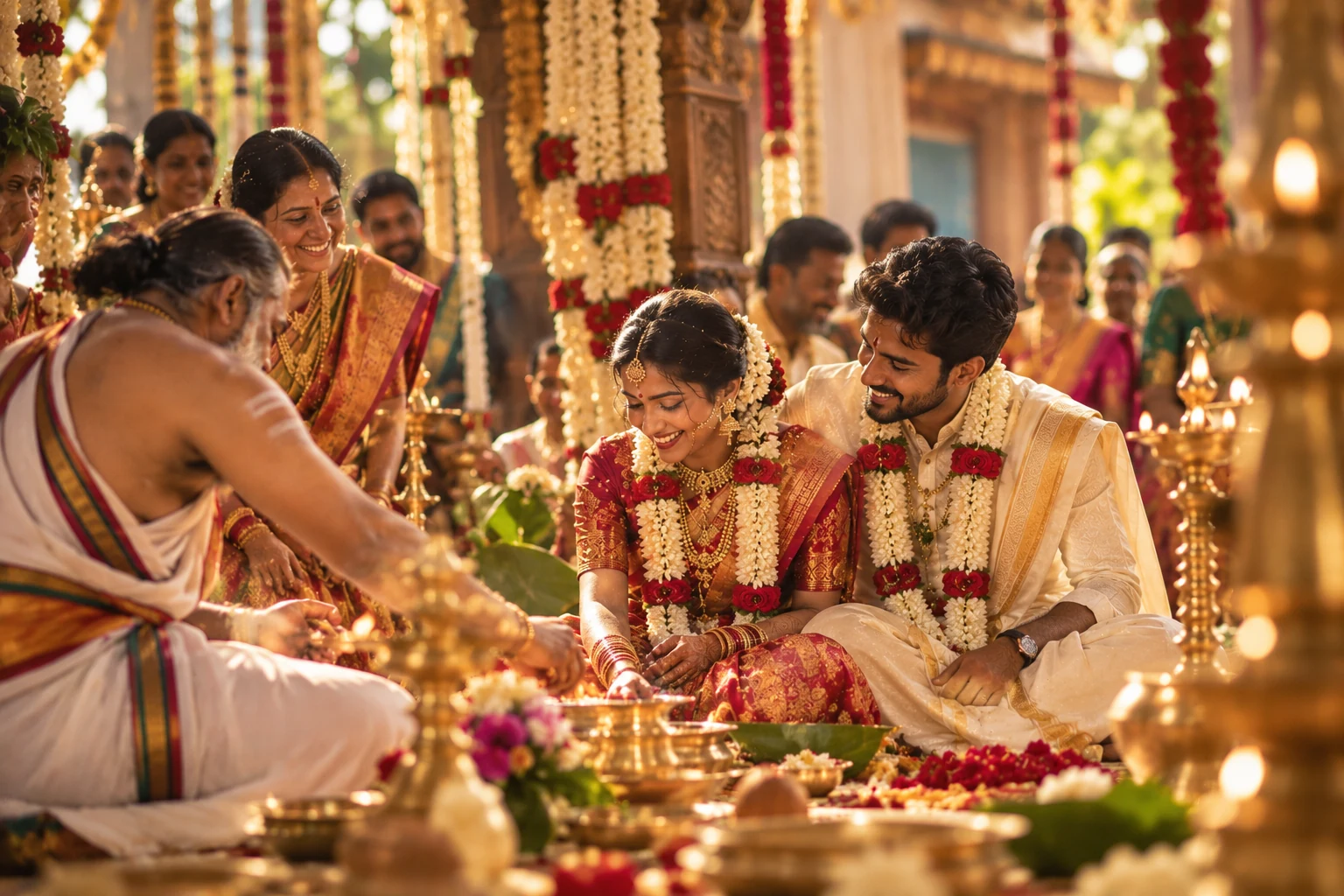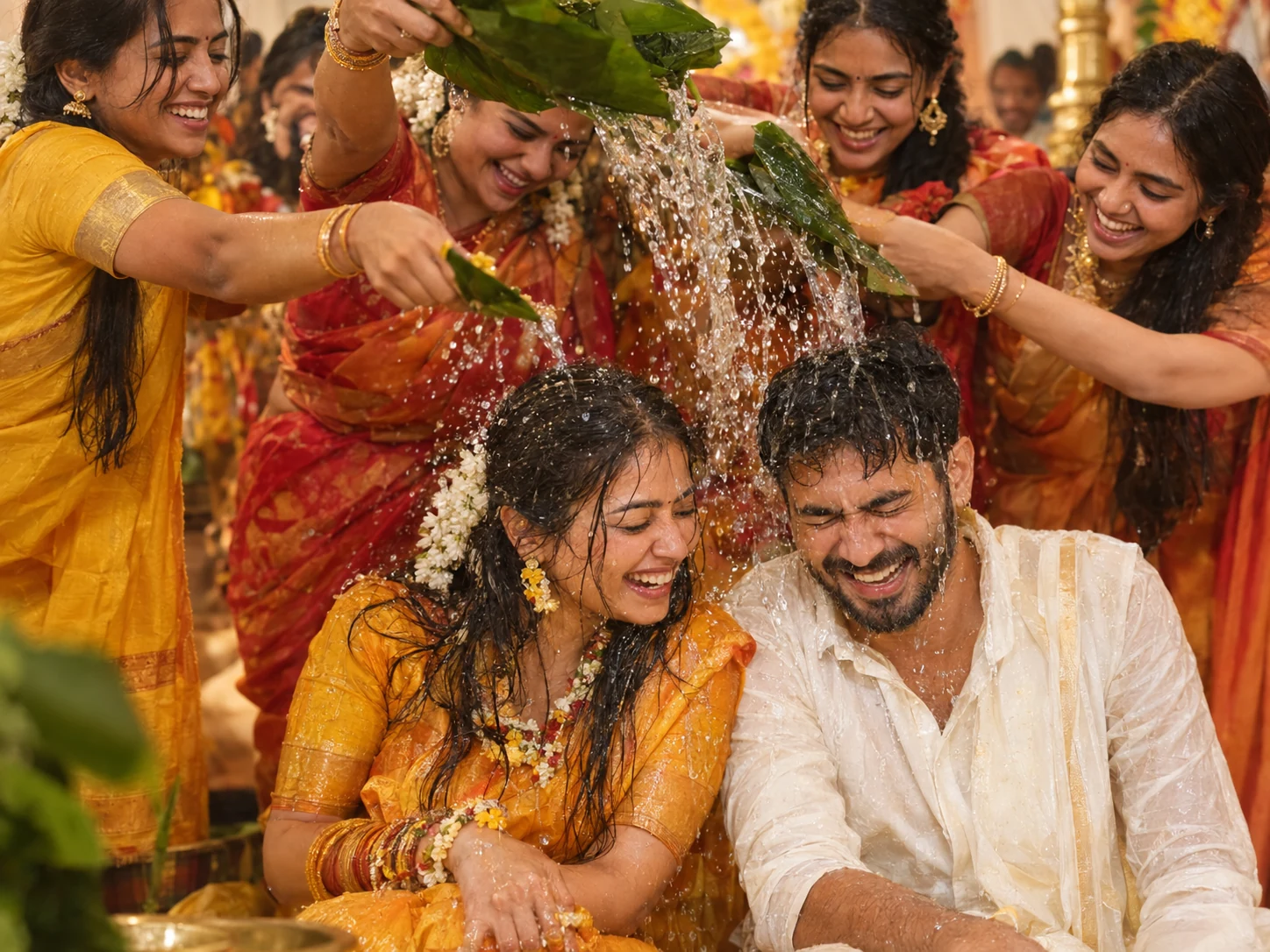
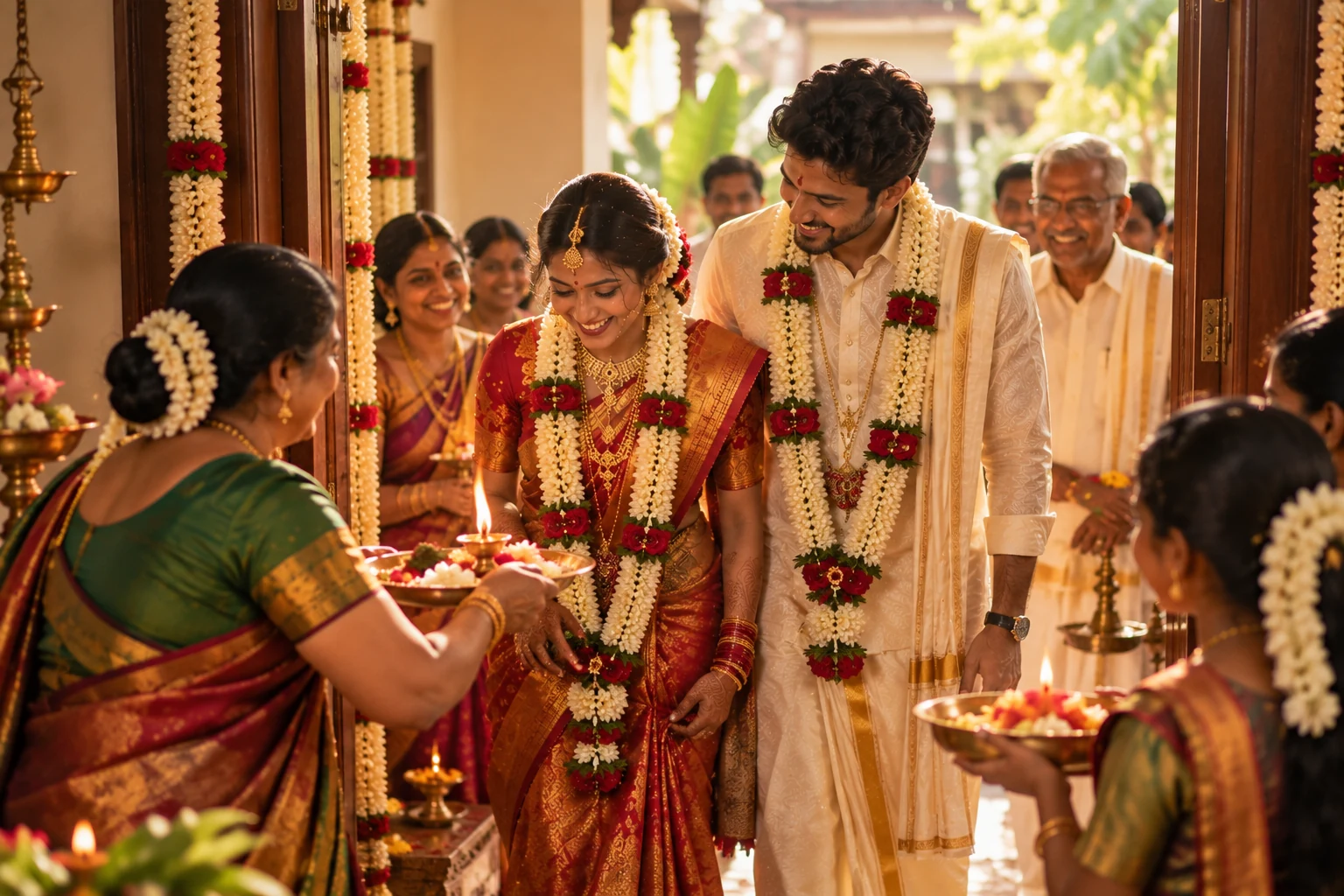
The wedding ends. The joining of two families continues.
There is a particular feeling in the days immediately after a wedding.
The hall has emptied. The flowers have begun to come down. The clothes that took months to choose are folded away. Everyone is tired, relieved and still talking about moments from the ceremony.
But in many Tamil families, marriage does not simply conclude when the wedding day ends.
There are traditions that carry the couple—and their families—into the first days of married life.
One of them is Maruveedu Azhaippu.
At its heart, Maruveedu is associated with the newly married couple visiting family after the wedding and being welcomed with hospitality, food and affection. Different Tamil families observe it differently, and even the timing and sequence can vary.
Rather than treating those differences as inconsistencies, they tell us something important about the tradition:
Maruveedu belongs as much to family practice as it does to a wedding checklist.
What does Maruveedu mean?
The name itself gives us a way into the idea.
Veedu (வீடு) means home or house in Tamil.
Maruveedu is commonly used in connection with a post-wedding visit involving the newly married couple and their families. Sources documenting Tamil wedding customs describe Maruveedu as occurring after marriage, although the precise home visited, timing and accompanying customs aren't identical across communities.
That variation is important.
You may hear one relative describe exactly how Maruveedu should happen, only for another Tamil family to describe something quite different.
Neither experience needs to become the universal version.
For couples planning their wedding, the most useful starting point is therefore not an internet timetable.
Ask your family:
What does Maruveedu mean in our family?
A return after the wedding
For some families, an important part of Maruveedu is the newly married couple returning to or visiting the bride's family after the wedding.
Other documented traditions involve a sequence of visits between the two families rather than one isolated occasion.
That gives Maruveedu a significance beyond simply going somewhere after the wedding.
The marriage has created a new relationship between households.
The visits acknowledge it.
Why the return matters
A wedding can create a strange emotional contrast.
Everything changes—and yet the people you love are still the people you love.
For the bride in particular, older ways of talking about marriage can sometimes make it sound as though marriage means leaving one family and becoming part of another.
Maruveedu can carry a gentler message.
Marriage has changed the relationship, but it has not erased the family that came before it.
The exact interpretation will naturally differ from family to family.
But viewed this way, the return home is not simply another event.
It is reassurance.
Maruveedu Virunthu: welcoming the couple with food
And, as with so many family occasions, hospitality often means food.
You may hear people refer to Maruveedu Virunthu or connect Maruveedu with a family feast.
What appears on the table is not something Riya Invites should prescribe.
Family, region, dietary practice and religious observance can all shape the meal.
What matters is the gesture:
the newly married couple is being received and fed as family.
After the scale and formality of a wedding banquet, there can be something especially meaningful about sitting down to a meal that feels unmistakably like home.
Does Maruveedu happen the day after the wedding?
Not necessarily.
This is one of the places where online descriptions can become misleading.
Some documented family traditions place Maruveedu very close to the wedding, while others describe subsequent visits on particular days or at a later point.
So there is no useful reason for us to tell every couple:
“Maruveedu happens on Day X.”
Instead, confirm the timing with the elders involved in your wedding.
If your family observes Maruveedu, put it into the wedding schedule early—particularly if relatives are travelling or the couple is planning to leave immediately for a honeymoon.
What happens during Maruveedu?
This is another question without one universal answer.
Depending on family custom, the occasion may involve some combination of:
- welcoming the newly married couple;
- a meal or feast;
- spending time with close relatives;
- gifts or clothing;
- blessings;
- ceremonial items;
- and additional family customs associated with the first visits after marriage.
Some documented family practices include clothing, turmeric, kumkum, flowers, fruit and other items. Those details are useful as an example of one practice, not a shopping list every Tamil family needs to reproduce.
Your parents or grandparents may describe something simpler.
That is not a lesser version of the tradition.
It is simply yours.
The families are learning a new relationship too
Weddings understandably focus on the couple.
But marriage also changes the relationship between two families.
People who previously met as the bride's side and groom's side now have a continuing relationship with one another.
Post-wedding visits and feasts can become ways of strengthening these newly formed family relationships.
That makes Maruveedu especially interesting.
During the wedding, family joining is expressed through ceremony.
After the wedding, it begins to be lived through ordinary things:
entering one another's homes,
sharing meals,
learning personalities,
remembering who takes tea without sugar,
and slowly becoming familiar.
Tradition provides the occasion.
Family gives it meaning.
Planning Maruveedu without turning it into another wedding
There is one modern temptation worth resisting:
Maruveedu does not automatically need to become Wedding Event Number Seven.
If your family traditionally holds a substantial gathering, then of course plan for it properly.
But if the heart of your family's Maruveedu is simply welcoming the couple home and sharing a meal, it doesn't need an elaborate backdrop, coordinated stationery, a new visual theme and another production schedule simply because modern weddings make everything photographable.
Start with the tradition.
Then decide what the occasion genuinely requires.
You may only need to think about:
Who is coming?
Where will everyone gather?
Who is preparing or arranging the meal?
Are there particular customs or items your family observes?
Does the couple need another outfit?
Is anyone travelling?
Does anything need to happen at a particular time?
That's enough.
What should the couple wear?
There is no Riya Invites rule for a Maruveedu outfit.
Some families may give the bride or groom new clothing as part of their custom.
Other couples may simply wear something they already own.
If clothing is traditionally presented by your family, confirm that before buying another outfit unnecessarily.
And if your Maruveedu is an intimate family meal after several days of dressing for wedding events, choosing something comfortable is perfectly reasonable.
Not every meaningful moment needs to look like a reception.
A Malaysian Tamil Maruveedu
For Malaysian Tamil families, traditions inherited across generations may not look exactly as they do in Tamil Nadu today.
That doesn't make them incorrect.
Families adapt.
People live in different cities. Homes change. Wedding halls replace some home-based functions. Work schedules matter. Relatives travel between states and countries. Several days of wedding customs may be compressed into a weekend.
The useful question isn't whether your Maruveedu perfectly matches somebody else's.
It is whether your family understands what it is preserving—and whether that meaning still matters to you.
Where you're uncertain about a religious or ceremonial component, ask the elders or religious figures responsible for your own wedding rather than treating a social-media version as authoritative.
If both families do things differently
This may be the most realistic wedding-planning question of all.
One family says Maruveedu means one thing.
The other says it means something else.
Don't begin by deciding which side is correct.
Ask each family to explain what they normally do and why it matters to them.
Often the apparent disagreement is really about details:
when the visit occurs,
which home is visited,
who attends,
what is served,
whether gifts are exchanged,
or whether another family custom is combined with the occasion.
Once those expectations are visible, couples can decide how to honour what matters without attempting to perform every variation simultaneously.
More than an invitation back home
The most beautiful way to understand Maruveedu may be the simplest.
A wedding has just changed the shape of a family.
And then someone says:
Come home.
Come sit with us.
Come eat.
Come back not as though nothing has changed, but with an acknowledgement that something has.
There will be different versions of Maruveedu Azhaippu across Tamil families. Different foods. Different days. Different rituals. Different memories.
That variation doesn't weaken the tradition.
Perhaps it explains why it survives.
Because underneath the details is something families everywhere understand:
marriage creates a new home without making the old one disappear.