
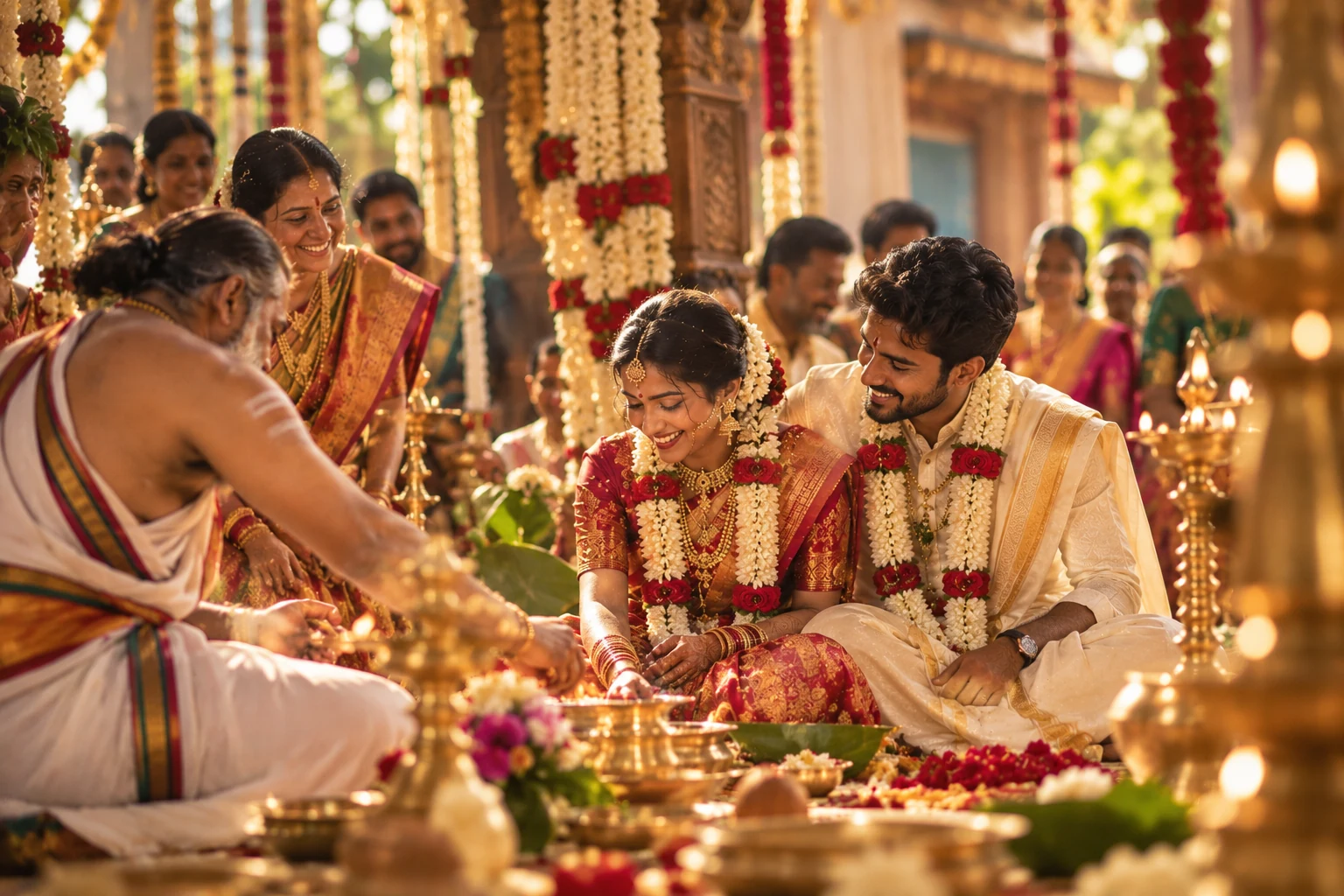
A wedding day shaped by family, faith and tradition
A Tamil wedding can be full of moments that feel instantly recognisable: flowers woven into hair, silk catching the light, relatives gathering around the couple, the sound of music and conversation, and a ceremony unfolding at the centre of it all.
But there isn't one single Tamil wedding-day sequence that every family follows.
Traditions may differ according to family practice, religious tradition, community, the temple or priest guiding the ceremony, and the way a couple chooses to bring their families together.
For Malaysian Tamil couples, those traditions may also sit within a distinctly Malaysian celebration—one shaped by the temples, wedding halls, families and communities that have carried them forward here.
This guide is therefore not a script for how a Tamil wedding must happen. Think of it instead as a way into understanding some of the moments you may encounter, and the questions worth asking as you plan your own.
Before trying to build the timeline, understand your ceremony
It is tempting to begin wedding-day planning by asking:
What happens first?
A better first question may be:
What does our family actually observe?
Speak with both families and, where relevant, the priest conducting your wedding before treating an online ceremony sequence as your own.
That conversation helps distinguish between traditions that are important to your families, customs that are optional, and elements that may not belong to your ceremony at all.
For planning purposes, that distinction matters. Your ceremony determines your schedule—not the other way around.
The arrival of the wedding party
Long before the central marriage rites begin, the wedding day may already be full of movement.
Families arrive. Relatives greet one another. The couple prepares separately. Offerings, garlands and ceremonial items are arranged. Musicians, photographers and coordinators find their places.
Depending on family tradition, there may also be particular customs surrounding the arrival or reception of the groom and his family.
Rather than assuming these moments are merely a prelude, include them when building your wedding-day schedule. They often involve people who need to be in a particular place at a particular time.
Garlands, greetings and moments of welcome
Flower garlands are one of the most visually familiar elements of many Tamil weddings, but the precise way they are incorporated can vary.
Where a garland exchange forms part of your ceremony, ask your family and priest when it happens and who needs to participate.
From a planning perspective, this is also a useful reminder that ceremonial objects shouldn't simply appear on a décor checklist.
Someone needs to prepare them, bring them to the venue and know when they are required.
The sacred centre of the ceremony
A Hindu wedding is more than a celebration surrounding a couple. Within Hindu tradition, marriage—vivāham—is regarded as a religious rite or samskara.
That context changes how we look at the wedding ceremony.
The prayers, offerings and actions led by the priest aren't simply decorative traditions to fit between photographs. They belong to the religious meaning of the marriage itself.
If you're unfamiliar with parts of your ceremony, ask your priest to explain them before the wedding. Understanding what is happening can make the day feel considerably less like a sequence you have memorised and more like something you are actually participating in.
The tying of the thaali
For many Tamil Hindu couples, one of the most recognised moments of the wedding is the tying of the thaali—the marriage pendant or sacred wedding necklace.
Its design, terminology and the customs surrounding it can differ between families and communities, so this is another moment where your own family's practice should lead.
What matters from a planning perspective is that something so significant should never be treated as just another item on a styling list.
Confirm in advance who is responsible for the thaali, where it will be kept before the ceremony and how your priest expects this part of the wedding to proceed.
Kanyadana and family participation
Some Hindu wedding traditions include kanyadana, a rite involving the bride's family.
The exact form and interpretation of the rite—and whether it forms part of a particular couple's ceremony—should be understood through the family's own tradition and priest rather than assumed from a generic wedding checklist.
That same principle applies more broadly to family participation.
Parents, siblings and other relatives may have specific ceremonial roles. Identifying those people ahead of time makes the ceremony easier for everyone to follow and prevents an important family member from being somewhere else when they are suddenly needed.
Saptapadi: seven steps
Another important rite found in Hindu marriage tradition is saptapadi, literally the taking of seven steps.
You may encounter different explanations, wording and ways of performing these steps depending on tradition.
Rather than reducing them to a one-line description copied from another wedding, couples who will include saptapadi can ask their priest to explain its significance within their ceremony.
It is a small planning conversation that can make a deeply symbolic moment much more meaningful.
Blessings and the transition from ceremony to celebration
Eventually, the formal ceremony gives way to congratulations, blessings, photographs, meals and whatever celebration follows.
This transition deserves its own planning.
If hundreds of guests need to move from a ceremony hall to a dining area, if immediate family photographs need to happen before relatives leave, or if the couple needs time to change attire before a reception, those minutes matter.
A wedding-day timeline should leave space for human movement—not just ceremonies.
What guests should know
Guests do not need a textbook explaining every ritual.
But thoughtful communication can help people participate respectfully, particularly when guests come from different cultural or religious backgrounds.
A wedding website, programme or simple note can explain:
- where the ceremony is taking place;
- expected arrival time;
- appropriate attire where relevant;
- whether footwear needs to be removed in a temple;
- approximately how long the ceremony may last;
- and any venue-specific expectations.
Building your Tamil wedding-day timeline
Once you understand the ceremony your families are actually planning, then turn it into a timeline.
Start with the fixed ceremonial time and work outward.
Allow for getting ready, travel, family arrivals, preparation of ceremonial items, the ceremony itself, blessings, photographs, meals, attire changes and reception arrangements where applicable.
And build in breathing room.
A timeline should help everyone understand the day. It shouldn't make a sacred and emotional occasion feel as though it is running against a stopwatch.
What to confirm with your family and priest
Before finalising the wedding-day schedule, confirm:
- which rites your ceremony will actually include;
- their correct sequence for your tradition;
- who participates in each one;
- what ceremonial items are required;
- who is responsible for bringing those items;
- the expected duration;
- temple or venue requirements;
- and anything guests should know beforehand.
If the advice of a generic online wedding timeline conflicts with the guidance of the family or priest responsible for your ceremony, the generic timeline is not the authority.
Make the ceremony your starting point
The most useful wedding-day plan isn't necessarily the one with the most detailed spreadsheet.
It is the one built around what matters.
Understand the ceremony first. Listen to the people carrying those traditions. Then organise the photographers, vendors, meals, clothes and schedule around it.
That approach leaves room for something a wedding timeline can easily lose sight of: you are not simply managing an event. You are experiencing your wedding day.